Connect this guide with the rest of your visit in the Osaka trip planner. Read how the research is made and what its sources establish.
At a glance
Start here
- Dotonbori developed as a canal-side theater and entertainment district.
- Bunraku combines narrative recitation, shamisen music, and puppetry.
- Osaka Shochikuza links the district's stage history with twentieth-century theater and film.
- Namba's contemporary comedy venues continue a broader culture of live popular entertainment.
01
The theater district came before the neon image
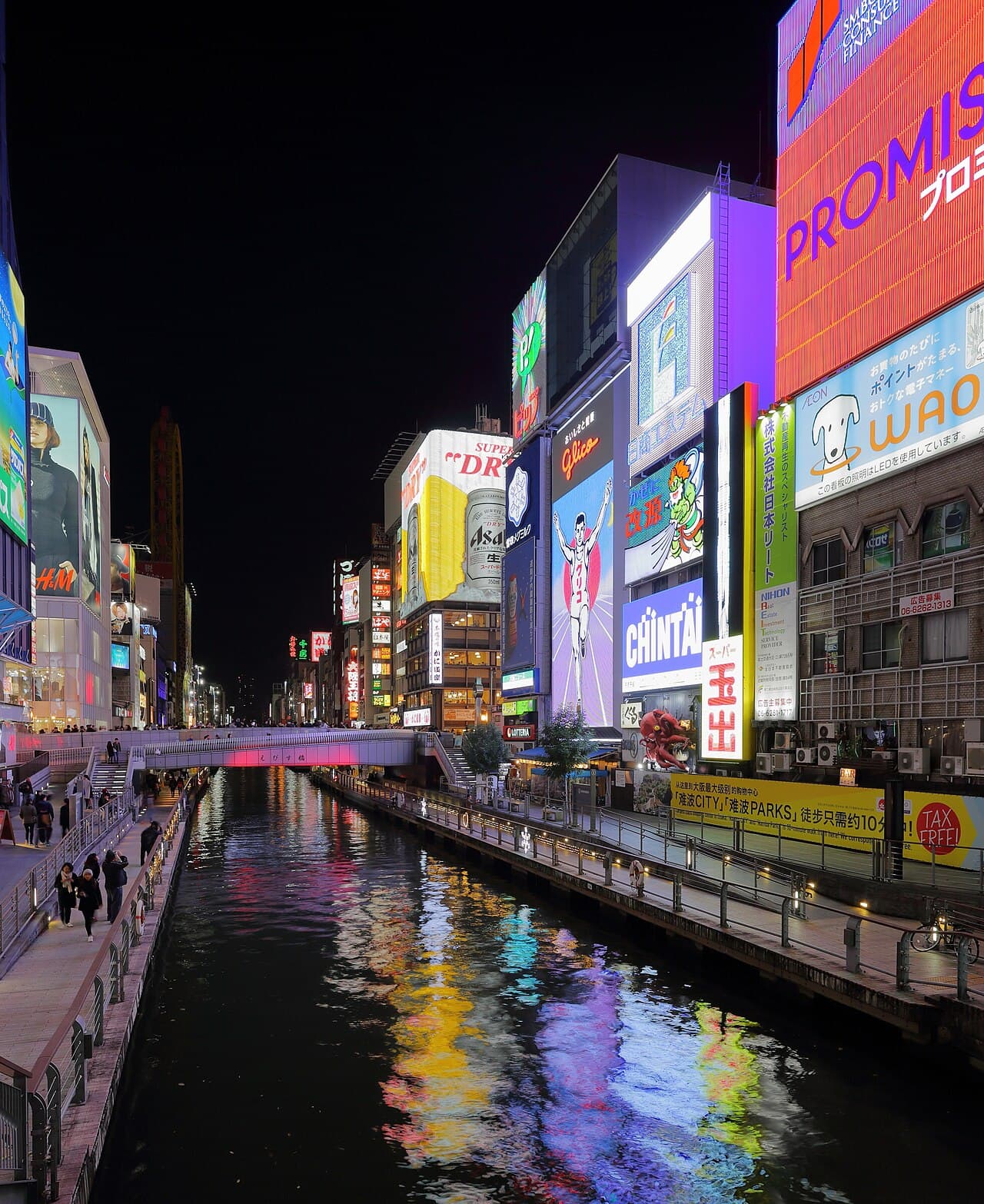
Osaka's official Dotonbori guide traces the canal name to Yasui Doton and describes theaters gathering along the south side after the waterway was dug. Kabuki, puppet theater, narrative performance, and popular spectacles made the area a destination long before electric signs became its defining visitor image.
The canal, performance halls, and dining businesses reinforced each other. Audiences arrived, spent time before and after shows, and created demand for visible storefronts. The later competition among large signs belongs to that attention economy. Dotonbori's visual intensity is therefore connected to entertainment history rather than being an isolated modern quirk.
- Read the canal as the organizing line of the district.
- Locate theaters as well as famous signs.
- Connect dining density with audience movement.
02
Bunraku is a three-part collaboration
The Japan Arts Council defines Bunraku through the synchronization of narrative recitation, shamisen music, and puppetry. Watching only the puppet can therefore miss much of the form. The narrator carries multiple voices and dramatic momentum, the shamisen shapes the musical field, and the puppeteers produce detailed movement in shared view of the audience.
This is adult dramatic theater, not a general children's puppet show. Stories, musical pacing, and performance conventions reward preparation. Use the council's official introduction before booking, then read the synopsis and any guidance attached to the actual production. Do not promise an English device or explanation unless the current performance page lists it.
- Listen to the narrator as closely as you watch the puppet.
- Notice how shamisen sound structures dramatic change.
- Check the production page for synopsis and language-support details.
03
Bunraku survived institutional change
The Japan Arts Council's history records performance continuity through changing theaters and managers, wartime destruction, postwar resumption, national cultural recognition, and the opening of the National Bunraku Theatre in Osaka in 1984. The present theater is therefore part of a long process of sustaining and reorganizing the art.
The National Bunraku Theatre also hosts explanatory material and exhibitions alongside performances. Its schedule is seasonal rather than an every-night attraction. That makes advance research essential: if no Bunraku production aligns with a visit, the official learning material can still establish context, but the article should not imply a performance will be available.
- Check the National Bunraku Theatre's current schedule first.
- Read the official history before seeing a production.
- Distinguish the art form from the current theater building.
04
Osaka Shochikuza carried theater into film modernity
Shochiku's corporate history records Osaka Shochikuza opening in Dotonbori in 1923. It later operated as a first-run film theater, closed in the 1990s, and reopened as a newly built theater in 1997. Those changes connect live performance, cinema, rebuilding, and commercial entertainment on the same historic theater street.
Today, the building's program must be checked directly because genre and schedule vary. Its value in this story is not a guarantee of a particular Kabuki performance. It shows how Dotonbori's theater identity adapted to new media and new buildings rather than ending when earlier playhouses disappeared.
- Use the official performance calendar for the actual visit date.
- Separate the 1923 opening from the present rebuilt theater.
- Notice how the facade addresses the Dotonbori street.
05
Popular comedy keeps the live circuit active
Namba Grand Kagetsu's official visitor listing identifies manzai, rakugo, and Yoshimoto Shinkigeki among its stage forms. These are not interchangeable labels, and a single bill may include multiple acts or theater formats. Read the named program before buying rather than treating every performance as generic stand-up.
The venue sits in Namba rather than directly on the canal, extending the entertainment geography into the surrounding Minami district. Language remains a practical consideration because comic timing and wordplay matter. Check the official show page for the named acts, format, duration, and any visitor support before treating a performance as suitable for your group.
- Identify the performance format before buying.
- Do not assume visual comedy removes every language barrier.
- Use the current venue schedule, not a generic Osaka listing.
06
Food and signs followed the audience
The official Dotonbori history explains that restaurants grew around theatergoers and that oversized signs competed for attention. Even a famous mechanical or character sign can therefore be read as a form of popular performance: it addresses moving crowds, creates recognition, and turns the street itself into a stage between formal shows.
This does not mean every restaurant or sign is historically continuous. Tenants, designs, and brands change. The durable pattern is the close relationship between spectacle, audience circulation, and eating. Walk once in daylight to see theater facades and canal form, then return after dark only if you want to compare how lighting changes the same entertainment corridor.
- Look above ground-floor storefronts for theater architecture.
- Keep bridge and entrance approaches clear while observing signs.
- Do not infer a venue's age from a retro-looking facade.
07
Plan around a real performance, not a category
Begin with the official calendars for the National Bunraku Theatre, Osaka Shochikuza, and Namba Grand Kagetsu. Record the exact production, date, start time, ticket source, language information, and late-arrival rule. If none fits, keep the district walk as an urban-history feature rather than inventing an interchangeable show.
Build the evening around one performance. Arrive early enough to find the entrance and understand any ticket collection process, then place food before or after according to the actual running time. The neighborhood is dense, but density does not remove queues, sold-out dates, or language needs. Current theater information should control the plan.
- Book only through the venue or its named official ticket channel.
- Confirm the production format and visitor support.
- Set one meeting point away from crowded entrances.
Useful answers
Reader questions
What is Bunraku?
Bunraku is a collaborative theater art combining narrative recitation, shamisen music, and puppetry. The National Bunraku Theatre in Osaka presents major productions on a seasonal schedule.
Sources: Japan Arts CouncilIs there always a Bunraku performance in Osaka?
No. Major productions run in particular periods, and schedules change. Check the National Bunraku Theatre's current calendar for your dates before planning around a performance.
Sources: Japan Arts CouncilWhat kinds of comedy appear at Namba Grand Kagetsu?
Official visitor information lists forms including manzai, rakugo, and Yoshimoto Shinkigeki. Check the exact program because acts and formats vary by performance.
Sources: Osaka Convention and Tourism BureauWhy did Dotonbori become a food and sign district?
Official local history links the canal-side concentration of theaters with restaurants serving audiences and later competition among large signs for attention. The entertainment and food histories developed together.
Sources: Osaka Convention and Tourism BureauRead the evidence
Sources and further reading
These sources support the relevant sections above. Plans and comparisons are editorial suggestions. Check operators for current arrangements.
- Dotonbori ↗Osaka Convention and Tourism Bureau · Research date 14 September 2026
Canal and theater-district development, relationship with restaurants, present performance venues, and large-sign culture.
- Bunraku at the National Bunraku Theatre ↗Japan Arts Council · Research date 14 September 2026
Bunraku's three-part performance form, Osaka theater, seasonal schedule pattern, exhibitions, and official planning links.
- Invitation to Bunraku: Opening of National Theatre and National Bunraku Theatre ↗Japan Arts Council · Research date 14 September 2026
Institutional history, wartime loss, postwar revival, cultural recognition, and 1984 Osaka theater opening.
- The history of Shochiku ↗Shochiku · Research date 14 September 2026
Osaka Shochikuza's 1923 opening, film-theater phase, closure, and 1997 reopening.
- Namba Grand Kagetsu ↗Osaka Convention and Tourism Bureau · Research date 14 September 2026
Namba venue location and live formats including manzai, rakugo, and Yoshimoto Shinkigeki.